

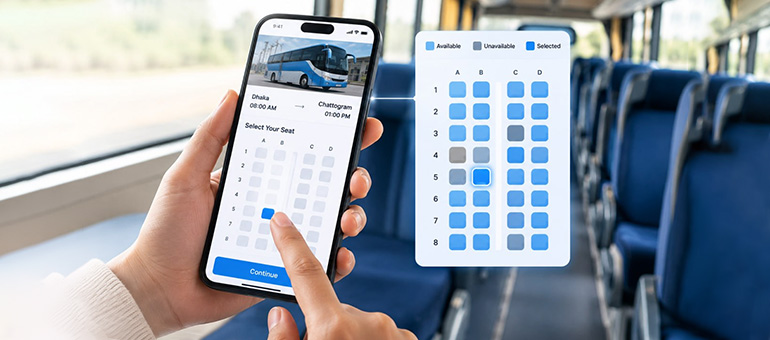
Ever wondered why two people rarely end up booking the same bus seat when tickets are sold through a booking platform?
The answer lies in real-time seat availability — a system that keeps track of every seat, updates its status as live bookings happen, and prevents multiple passengers from reserving the same seat.
Let’s understand how it works in a bus ticket booking system.
From a passenger’s perspective, the process looks simple. But behind the simplicity, there’s a system that continuously updates seat status across booking channels to prevent outdated information and double bookings.
What actually happens in those few seconds between selecting a seat and completing a booking? Let’s find out below.
What Happens When You Select a Seat?
Every bus trip has a digital seat inventory linked to a specific bus, route, and departure time. When you open the seat map, the booking system checks this inventory and displays the current status of each seat.
For example, a seat could be marked as:
- Available: Ready to be selected.
- Held: Temporarily reserved while another passenger completes payment.
- Booked: Successfully purchased and no longer available.
- Released: Made available again after cancellation or an expired hold.
This process enables live seat availability tracking, so passengers don’t have to rely on a static seat chart that’s different from the actual booking scenario.
Why Are Seats Temporarily Held?
Suppose one passenger selects the seat “B2” of a specific trip at 10:22:38.
Another passenger selects the same seat at 10:22:39.
If the system allowed both to proceed without checking the latest status, both could potentially pay for the same seat.
To prevent this, the booking system uses a temporary locking mechanism. It temporarily locks the seat when a passenger selects it. The seat status changes from Available to Held for a limited period while the passenger completes payment.
If payment succeeds, the system changes the status to Booked. If the passenger abandons the booking or the timer expires, the seat is automatically released and becomes available again.
How Do Different Booking Channels Stay Updated?
Bus operators often sell tickets through multiple channels, including websites, mobile apps, ticket counters, travel agents, and travel aggregators. All of these channels need access to the same or synchronized seat inventory.
For example, when a passenger purchases Seat 18A at a ticket counter, the online booking system must know that Seat 18A is no longer available. Similarly, if someone books the seat online, the counter should not continue showing it as available.
This is where ticket inventory management becomes important. A centralized booking system can synchronize seat information across different sales channels and update availability as bookings, cancellations, and holds occur.
How is Seat Availability Updated in Real Time?
The booking system needs to update the inventory whenever a seat changes status. Technologies such as APIs, databases, and real-time communication can help sync these changes to connected booking interfaces. As a result, a passenger viewing a seat map can receive an updated status when another booking changes the inventory.
The database, in the meantime, remains the source of truth, while real-time updates help different users and channels see those changes quickly.
Why Does Real-Time Seat Availability Matter?
Accurate, real-time seat availability in bus booking systems helps keep the booking process consistent from seat selection to payment while giving passengers and operators a reliable view of the same seat inventory.
For passengers, accurate seat information means they can confidently choose seats and avoid unpleasant situations during checkout. For bus operators, it helps reduce double bookings, outdated seat maps, and manual coordination between sales channels.
Ultimately, real-time seat availability is the combination of synchronized inventory, temporary seat holds, payment confirmation, cancellations, and continuous status updates. What looks like a simple colored seat map is actually the visible part of a system designed to keep bus seat inventory accurate throughout the entire booking process.
Read Next: How Does Ticket Booking Software Work? The Logic of Digital Ticket Booking